NAD+ Decline: The Hidden Clock Behind Fatigue, Brain Fog, Wrinkles — And Why Mental & Sexual Health Fade Too
Why a 50% drop in one coenzyme explains the afternoon crashes, brain fog, emotional reactivity, skin dullness, and quieter libido that most doctors dismiss as "just ageing" — and what the science says you can do about it.
ELUME Editorial
She was 44. A senior director, mother of two, weekend runner. By every measurable standard, she was doing everything right. And yet something had shifted.
The afternoon crashes were relentless — not "a bit tired", but a fog that settled around 2 pm like a curtain being drawn. She'd walk into a room and forget why. Her skin looked dull in the mirror even after eight hours of sleep. Her libido was quiet in a way that had nothing to do with stress. And the irritability — snapping at her children for things she'd have laughed off a decade ago — felt foreign to her own character.
Her GP found nothing wrong. Her bloods were "fine". The diagnosis, implicit and dismissive, was: this is just ageing.
But it wasn't just ageing. It was a specific, measurable, addressable biological process — and it had a name.
What is NAD+, and why should you care?
NAD+ (nicotinamide adenine dinucleotide) is a coenzyme present in every single cell in your body. It is not optional. Without it, your cells cannot produce energy, cannot repair damaged DNA, cannot activate the sirtuins — the proteins scientists have linked most closely to longevity and metabolic resilience.
Think of NAD+ as the fluid inside a battery. The battery itself — your cell — may be intact. But without sufficient fluid, it cannot hold a charge, it cannot power anything, and over time, it begins to deteriorate.
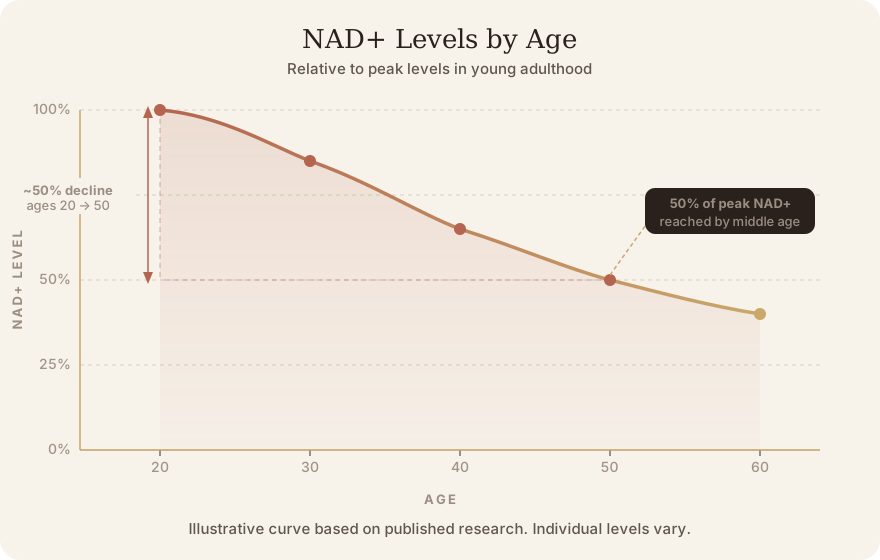
The problem that virtually every adult over 35 is living with: NAD+ levels decline by approximately 50% between your 20s and your 50s. This is not a marginal shift. It is a halving of one of the most critical molecules in human biology — and it happens silently, gradually, across every system in the body at once.
The five ways NAD+ decline shows up in your life
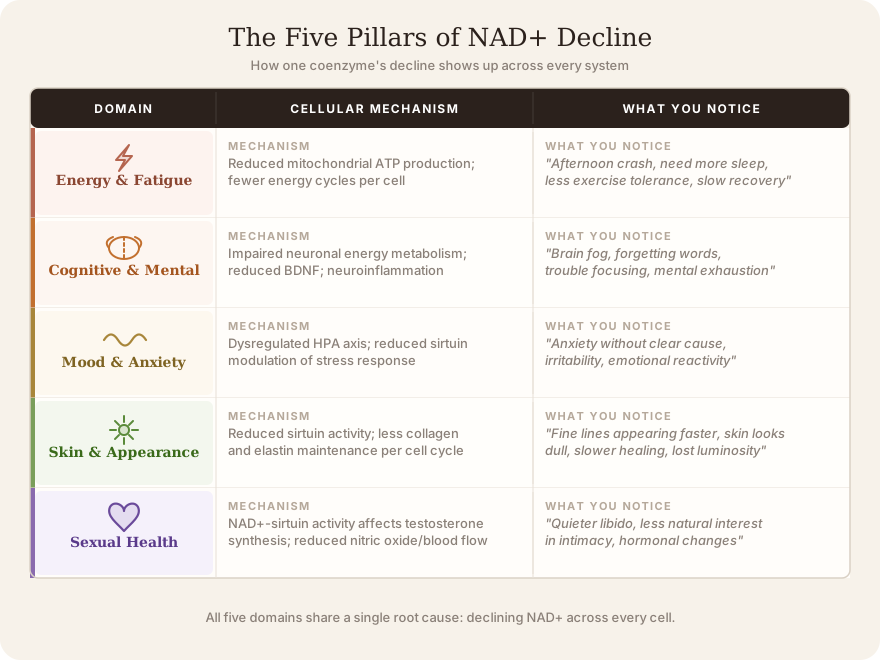
NAD+ depletion doesn't announce itself with a single clear symptom. It shows up across five interconnected domains — and because the effects are diffuse, most people attribute them to stress, poor sleep, or simply "getting older". They are right about all three, but they are missing the common thread beneath.
1. Energy and fatigue — your mitochondria are running low
Your mitochondria — the energy factories inside each cell — depend on NAD+ to produce ATP, the molecule that powers virtually every biological process. When NAD+ falls, mitochondrial efficiency falls with it. The result is not dramatic collapse but something arguably harder to bear: a persistent, inexplicable fatigue that sleep doesn't fully resolve.
You notice it as the afternoon crash that coffee no longer fixes. As exercise that feels harder for the same output. As the sense that your recovery — from workouts, from illness, from stress — is slower than it used to be. This is cellular energy depletion, playing out in real time.
2. Brain fog and cognitive decline — your neurons are underpowered
The brain is one of the most metabolically demanding organs in the body. Neurons require extraordinary quantities of ATP, and cognitive function — memory consolidation, sustained attention, executive processing — is acutely sensitive to mitochondrial efficiency.
Low NAD+ means underpowered neurons. It means reduced BDNF (brain-derived neurotrophic factor), the protein responsible for forming new neural connections. It means neuroinflammation — inflammatory cytokines that accumulate when NAD+-dependent repair mechanisms slow.
The experience is brain fog: walking into rooms without knowing why, losing words mid-sentence, struggling to hold complex trains of thought, feeling mentally exhausted hours before your body is tired.
3. Mood, anxiety, and emotional reactivity — your stress system is fraying
This is the connection that surprises most people — and the one with some of the most compelling emerging evidence.
NAD+-dependent enzymes regulate the synthesis and metabolism of serotonin and dopamine. Sirtuins — which require NAD+ to function — modulate the HPA axis, the body's central stress-response system. When NAD+ is depleted, stress resilience falls. The HPA axis becomes dysregulated. The buffer between stimulus and reaction — the neural resources that allow you to pause before responding — diminishes.
The result is emotional reactivity that feels out of character. Anxiety that arrives without a clear cause. Irritability that seems disproportionate to the trigger. And a vicious cycle: chronic stress itself depletes NAD+, which further reduces the capacity to handle stress. Once you're caught in this loop, conventional advice — "just manage your stress better" — misses the biological foundation beneath the behaviour.
The 2024 systematic review published in the American Journal of Physiology: Endocrinology and Metabolism (Gindri et al.) documented anxiety reduction as a measurable clinical outcome following NAD+ precursor supplementation, including after structured stress tests. This is not anecdote. This is a signal in the data.
"Supplementation with NADH and precursors was well tolerated and observed clinical results such as a decrease in anxiety conditions… increased muscle insulin sensitivity, quality of life, fatigue intensity, and sleep quality." — Gindri et al., Am J Physiol Endocrinol Metab, 2024
4. Skin and appearance — your sirtuins have gone quiet
Sirtuins are a family of proteins associated with DNA repair, inflammation control, and — critically for skin — collagen and elastin maintenance. They require NAD+ to function. When NAD+ falls, sirtuin activity falls. When sirtuin activity falls, the cellular machinery that maintains skin's structural integrity operates at reduced capacity.
The visible consequences are familiar: fine lines that appear faster than expected, a loss of the luminosity that once came without effort, slower healing from minor damage, and a dullness that skincare products address at the surface but cannot resolve at the source.
This is why longevity-oriented skincare scientists speak increasingly of cellular health, not just topical ingredients. The skin you see is downstream of the biology you cannot.
5. Sexual health — libido, hormones, and the energy of intimacy
Of all the domains of NAD+ decline, this is the one most likely to go unspoken — and the one that affects quality of life and relationship health most directly.
Testosterone synthesis in both men and women depends on NAD+-dependent sirtuin activity. Blood flow — the foundation of erectile function, arousal, and sensation — requires healthy endothelial cells with functional mitochondria, and nitric oxide production depends on the same energy pathways NAD+ powers. Hormonal balance in women, including oestrogen metabolism, requires adequate liver mitochondrial function.
What people notice is not always identified as a hormone or energy issue. It arrives as a quieter libido, less natural interest in intimacy, changes in erectile quality or vaginal lubrication, and a general sense of reduced vitality in this dimension of life — often attributed to "stress" or "just how it is at this age".
It is not simply how it has to be. It is, at least in part, a metabolic and mitochondrial story.
Why does NAD+ decline in the first place?
Understanding the mechanisms makes it clear why this is not an inevitable feature of ageing, but an accelerated process that modern life worsens — and that targeted support can address.
PARP overactivation — the DNA repair tax
PARP enzymes repair damaged DNA. As we age, DNA damage accumulates faster — from UV exposure, environmental toxins, metabolic stress. PARPs are voracious NAD+ consumers. An ageing body with high DNA damage burden depletes NAD+ repairing it, leaving less available for everything else.
CD38 — the NAD+ consumer that rises with age
CD38 is an enzyme that increases in activity as we age. Its primary function involves immune signalling, but it consumes NAD+ as a substrate. Researchers have found that aged tissues show dramatically elevated CD38 activity — and this alone can account for a significant portion of age-related NAD+ decline.
Chronic stress — the accelerant
Psychological and physiological stress both activate inflammatory pathways that consume NAD+. Chronic stress creates a self-reinforcing spiral: depleted NAD+ reduces stress resilience, which increases stress, which depletes more NAD+. This is not metaphorical — it is a documented metabolic loop.
Poor sleep — the missed restoration window
Cellular NAD+ is partially restored during deep sleep, when metabolic demands are lowest and repair processes are prioritised. Insufficient or fragmented sleep disrupts this restoration cycle, compounding depletion. Notably, the 2024 Gindri review documented sleep quality improvement as a measured outcome of NAD+ precursor supplementation — suggesting the relationship runs in both directions.
What the research says about restoration
The 2024 systematic review (Gindri et al.) synthesised human clinical data on NAD+ and NADH precursor supplementation across multiple populations and endpoints. The documented findings are notable for their breadth:
- Anxiety reduction — measured after standardised stress tests, not just self-reported.
- Fatigue improvement — including in chronic fatigue syndrome patients, a population with severe NAD+ depletion.
- Sleep quality enhancement — quantified across multiple study designs.
- Insulin sensitivity improvement — with implications for metabolic and hormonal health.
- Safety and tolerability — well-tolerated across dosage ranges with low incidence of adverse events.
NMN (beta-Nicotinamide Mononucleotide) has emerged as the most clinically studied direct NAD+ precursor. As a molecule, NMN crosses cell membranes efficiently and is rapidly converted to NAD+ inside the cell — bypassing several conversion steps that older precursors (like niacin) require. Human trials using doses from 100 mg to over 1,000 mg daily have demonstrated measurable NAD+ elevation, improved muscular energy metabolism, and enhanced metabolic markers.
Critically: effects build over weeks, not days. This is cellular restoration, not stimulation. The expectation should be gradual, systemic improvement rather than an immediate caffeine-like lift.
How ELUME addresses NAD+ restoration
Two ELUME formulations directly address NAD+ decline — and they are designed to work in sequence, not in isolation.
ELUMÉ™ NMN+ 99.9 — direct NAD+ precursor restoration
Built on Uthever NMN, a patented form verified at 99.9% assay purity by independent third-party testing. Paired with trans-resveratrol (SIRT1 activation) and PQQ (mitochondrial biogenesis), it addresses NAD+ depletion through three complementary pathways simultaneously: fuel, amplification, and structural renewal.
The Longevity Ritual — clearing the path first
The principle behind the two-step protocol is sequence: RESET first (days 1-5), using fisetin, quercetin, and apigenin to reduce the senescent cell burden and inflammatory SASP signalling that actively depletes NAD+; then ACTIVATE (days 6-30) with NMN+ to restore into a cleaner, more receptive cellular environment.
The logic is architectural. You would not install new plumbing into a structurally compromised building without first addressing the foundation. Clearing senescent cells before restoring NAD+ means the restored molecule works in an environment that can actually use it.
NAD+ restoration is most effective when the cellular environment has been prepared to receive it. That is the principle the Longevity Ritual is built on.
Why synergy matters
Trans-resveratrol requires NAD+ to activate sirtuins — and sirtuins, once active, help preserve NAD+ by regulating the CD38 enzyme that consumes it. PQQ drives the creation of new mitochondria, increasing the surface area over which NAD+ can do its work. These are not independent actions stacked together; they are a mutually reinforcing system.
What cellular restoration can feel like
The clinical data describes population-level outcomes. What individuals report, across both clinical observations and customer accounts, tends to cluster around recognisable themes:
- Sustained energy across the afternoon — the crash becomes less defined, then absent.
- Mental clarity that returns gradually — words come more easily, focus holds longer.
- Emotional steadiness — the same situations feel less overwhelming, reactions feel more proportionate.
- Sleep that is deeper and more restorative, even at the same duration.
- A return to feeling more like oneself — an integration that is difficult to quantify but immediately recognisable.
These are not dramatic transformations. They are the quiet return of a baseline that had been silently eroding — and that most people had stopped expecting to recover.
Ageing is not a fixed trajectory
The woman at the beginning of this article — the one whose doctor told her this was just ageing — was not wrong to feel that something was off. Her instinct was correct. What she was missing was a biological explanation precise enough to act on, and a protocol grounded in mechanism rather than marketing.
NAD+ decline is real, measurable, and — within meaningful limits — addressable. The research exists. The mechanisms are understood. The tools are improving.
Ageing is not something that simply happens to us. It is a process — one we can understand, and one we can support intelligently, beginning at the cell.
Explore ELUMÉ™ NMN+ 99.9 — or start with the full Longevity Ritual.
This article is for educational purposes only and does not constitute medical advice. ELUME supplements are health supplements, not medicines, and are not intended to diagnose, treat, cure, or prevent any disease. Always consult a qualified healthcare professional before starting any new supplement protocol — especially if you are pregnant or breastfeeding, taking medication, or managing a medical condition. Use only as directed.