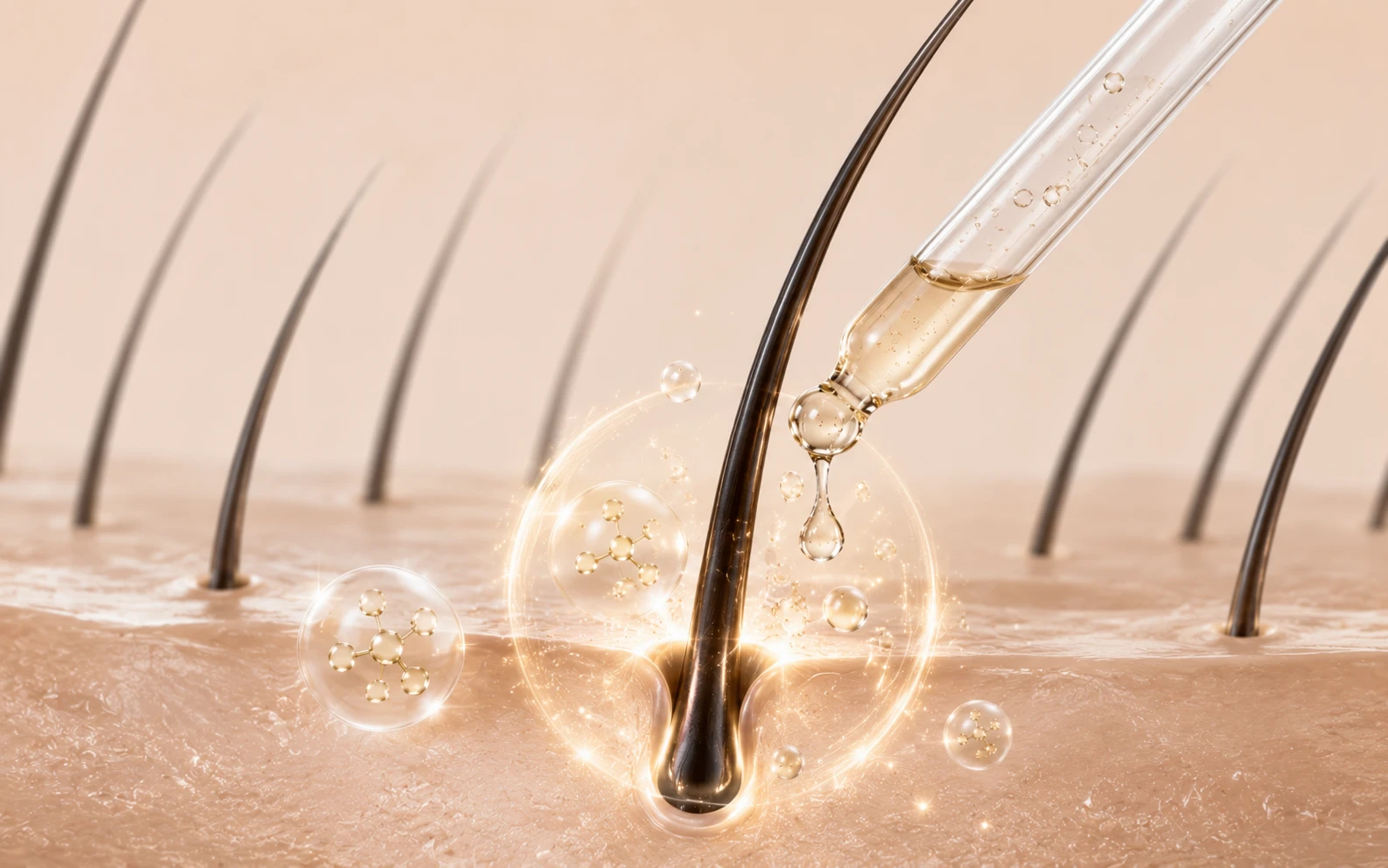
PDRN and Polypeptide Enriched Media (P.E.M) aka Stem Cell Conditioned Media: The Science of Scalp Regeneration
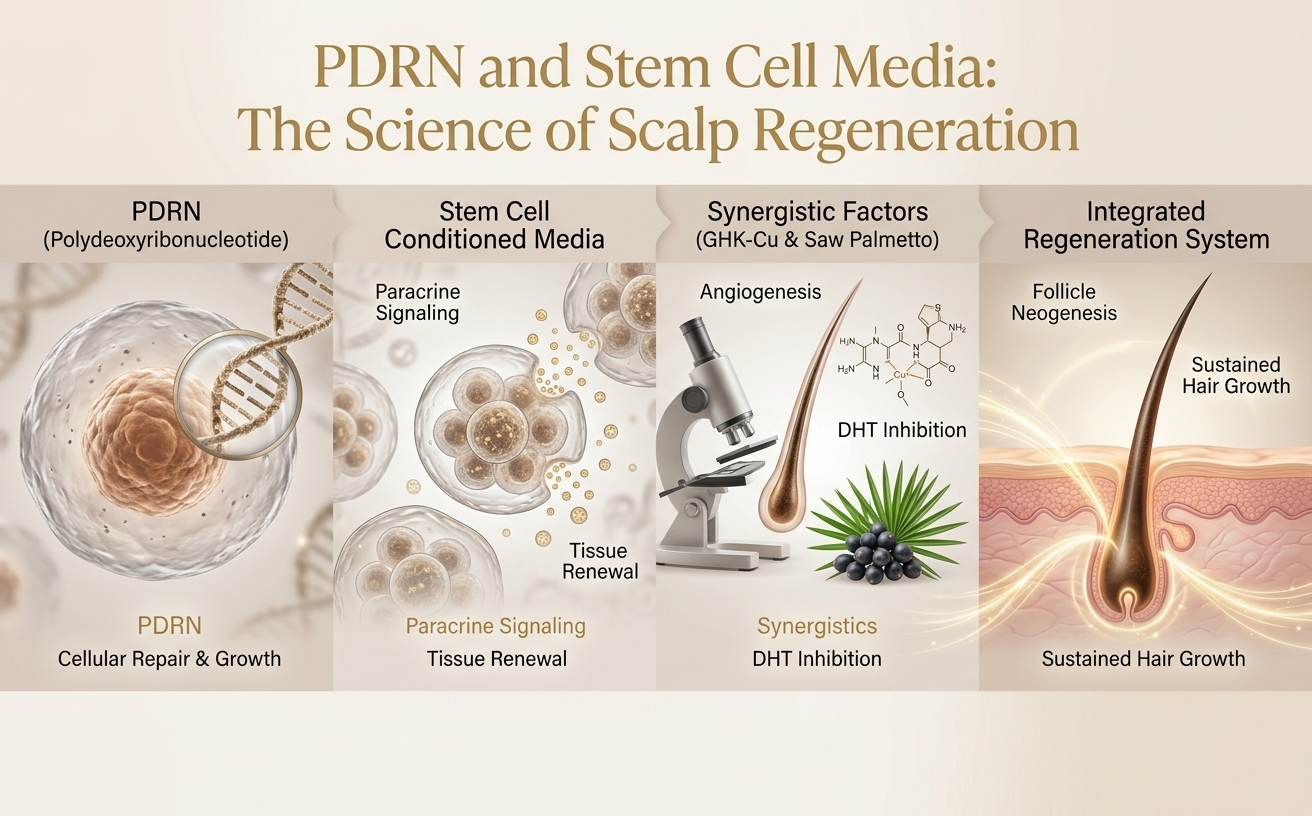
PDRN (Polydeoxyribonucleotide) and Stem Cell Conditioned Media(Polypeptide Enriched Media) work through distinct biological mechanisms to reverse follicle ageing and support hair regrowth. Combined with GHK-Cu copper peptides and Saw Palmetto, they form a complete scalp regeneration system — backed by clinical evidence.
ELUMÉ™ Editorial
 Hover to reveal
Most shampoos are built around a promise of clean — removing excess oil, calming the scalp, adding shine. A smaller number claim to support hair regrowth. Almost none address the question that determines long-term hair health at its root: what is actually happening inside the follicle as we age, and can it be reversed?
Two technologies are changing the answer. PDRN (Polydeoxyribonucleotide) and Polypeptide Enriched Media (P.E.M) aka Stem Cell Conditioned Media work through entirely different biological mechanisms to restore scalp health and reactivate follicle growth — and the clinical evidence behind both has advanced significantly in the past decade. Understanding each one separately is the starting point for understanding why, together, they represent a genuine frontier in hair loss treatment.
Why the scalp ages differently than skin
Facial skin and scalp skin share the same basic architecture — epidermis, dermis, subcutaneous layer — but the scalp ages through mechanisms that surface-focused skincare does not address.
Hair follicles are complex mini-organs, cycling through growth (anagen), regression (catagen), and rest (telogen) phases throughout life. As we age, this cycle degrades in a specific pattern:
Anagen phases shorten — each growth cycle produces shorter, thinner hair before the follicle rests again.
Dermal papilla cells decline — the specialised cells that signal the follicle to grow become fewer and less active.
Scalp microcirculation decreases — reduced blood flow means fewer nutrients and growth factors reach the follicle base.
Oxidative stress accumulates — free radical damage disrupts the signalling that coordinates growth cycles.
Chronic low-grade inflammation — often subclinical, without visible symptoms — progressively degrades dermal papilla function.
The result is not sudden loss but gradual miniaturisation — follicles producing progressively finer, shorter hairs over years. PDRN and Stem Cell Media each target different aspects of this decline.
What is PDRN? Restoring the Cellular Environment for Hair Regrowth
PDRN stands for Polydeoxyribonucleotide — a bioactive compound derived from highly purified salmon DNA. These long chains of nucleotides, structurally similar to human DNA, are processed to remove proteins and allergenic components, leaving only the nucleotide sequences themselves.
PDRN is not new to medicine. It has been used in wound healing, aesthetic dermatology, and sports medicine for over two decades — particularly in South Korea, where it is a frontline clinical tool for tissue regeneration. Its application to the scalp exploits the same core mechanism that makes it effective elsewhere: activation of A2A adenosine receptors.
The A2A receptor cascade
When PDRN binds to A2A adenosine receptors on follicle cells and dermal papilla, it triggers a well-characterised regenerative cascade with three distinct effects: upregulation of VEGF (vascular endothelial growth factor), stimulating new capillary formation and increasing blood supply to the follicle base; suppression of TNF-α, an inflammatory cytokine that actively impairs follicle cycling; and promotion of collagen synthesis in the dermal sheath surrounding the follicle.
Three regenerative cascades activated by a single receptor mechanism — PDRN's specificity is what makes it effective at the follicle level.
DNA repair substrate supply
Dermal papilla cells engaged in rapid division during anagen require nucleotides as raw material. PDRN provides this substrate directly, reducing the metabolic cost of the growth phase and supporting the fidelity of cell division. This is the same mechanism exploited in wound-healing applications: when repair demand is high, external nucleotide supply reduces cellular stress and supports tissue fidelity.
PDRN does not stimulate hair growth through a single pathway. It restores the conditions in which the follicle can sustain its own natural growth cycle.
Clinical evidence
The landmark clinical validation of PDRN for hair loss came from a study published in Wound Repair & Regeneration (Lee SH et al., 2015 — PMID: 25524027), involving 60 patients with female pattern hair loss across three treatment arms over 12 weeks of weekly intra-perifollicular injections.
Lee et al. 2015 — both PDRN alone and combined therapy demonstrated statistically significant, clinically meaningful improvements at 12 weeks.
PDRN alone produced a 17.9% improvement in hair count and 13.5% increase in hair thickness (p < 0.001). Combined with PRP, these figures rose to 23.2% and 16.8% respectively — with the combination showing superior thickness improvement (p = 0.031). The multi-mechanistic principle is already visible in the data: more pathways addressed produces better outcomes.
What is Polypeptide Enriched Media aka Stem Cell Conditioned Media? Reactivating Dormant Follicles for Hair Loss
While PDRN works at the receptor level to restore the follicular environment, Stem Cell Conditioned Media operates at a different layer entirely — delivering the concentrated growth factor signals that dormant follicles need to re-enter active growth.
Stem Cell Media refers to the conditioned medium produced by mesenchymal stem cell (MSC) cultures — the complex secretome of growth factors, cytokines, and signalling proteins that stem cells release into their environment. Rather than introducing live cells, which raises regulatory and stability complexity, Stem Cell Conditioned Media delivers the bioactive signals those cells produce in a stabilised, topically applicable form.
The growth factor landscape
The secretome contains dozens of bioactive molecules. The chart below shows the key hair-regeneration cytokines measured in a skin and hair-specific assay panel — the concentration profile that gives Stem Cell Media its biological potency:
Stem cell media cytokine profile — hair-regeneration relevant factors across IGF signalling, matrix protection, and anagen promotion categories.
The most abundant factors in the IGF family (IGFBP-2, IGFBP-3, IGFBP-6) regulate insulin-like growth factor availability at the follicle — a primary driver of anagen phase length. VEGF supports the same angiogenesis pathway that PDRN's A2A cascade activates, creating a dual approach to scalp vascularisation. BMP-7, HGF, and GDF-15 directly promote follicle cell proliferation and anagen initiation. TIMP-1 and TIMP-2 protect the extracellular matrix from degradation, preserving the structural environment in which follicles grow.
Wnt/β-catenin activation
Beyond individual growth factors, Stem Cell Media has been shown to activate the Wnt/β-catenin signalling pathway — a master regulator of follicle stem cell activation. A 2025 study published in Theranostics (Shrestha M et al., PMID: 40585981) demonstrated that rapamycin-primed mesenchymal stem cell exosomes — an engineered form of stem cell secretome — significantly accelerated hair follicle development and increased hair density in vivo through Wnt/β-catenin activation and autophagy upregulation. This is the pathway PDRN's Wnt signalling contribution also touches, which is why the two actives create genuine synergy rather than simple addition.
Clinical comparison: secretome vs. minoxidil
A 2025 randomised controlled trial (Legiawati L et al., Archives of Dermatological Research — PMID: 40021536) directly compared adipose-derived stem cell secretome against minoxidil in 60 subjects with androgenetic alopecia. All groups showed statistically significant improvement (p < 0.05) at 12 weeks. The combination group demonstrated substantially superior hair growth parameters. Critically, the secretome group showed minimal side effects compared to minoxidil-related scalp irritation — a meaningful clinical distinction for daily use.
Stem Cell Media does not grow hair. It reactivates the follicle's own programme — giving dormant cells the growth factor signals they stopped receiving.
Why PDRN with GHK-Cu, Saw Palmetto, and Polypeptide Enriched Media (P.E.M) is more effective
Hair loss is multifactorial. No single pathway accounts for it, and no single active can address it fully. The ELUMÉ™ Follicle Longevity formulation pairs PDRN and polypeptide Enriched Media with two further actives that cover the mechanisms neither can reach:
Each active targets a distinct mechanism of follicle ageing — together they address what no single ingredient can.
GHK-Cu (Copper Peptide) rebuilds the structural matrix. It stimulates collagen and elastin synthesis in the dermal sheath surrounding the follicle; activates matrix metalloproteinases that remodel the extracellular matrix; and has shown the ability to enlarge follicle size in research, increasing hair shaft diameter. Where PDRN and Stem Cell Media restore signalling, GHK-Cu rebuilds the physical scaffold in which growth occurs.
Saw Palmetto addresses the androgenetic pathway. DHT (dihydrotestosterone) binds to receptors in scalp follicles and progressively shortens the anagen phase — the root mechanism behind pattern hair thinning. Saw Palmetto inhibits 5-alpha reductase, reducing DHT conversion at the scalp, with a safety profile considerably better than pharmaceutical inhibitors. For follicles whose miniaturisation is driven by androgenetic sensitivity, this is a root cause the other actives cannot touch.
The logic is architectural: regenerative environment from PDRN, growth factor reactivation from Stem Cell Media, structural scaffolding from GHK-Cu, hormonal protection from Saw Palmetto. These are not interchangeable. Remove any one and a pathway of follicle ageing remains unaddressed.
What this means for your scalp, practically
What was once only accessible through clinical injection protocols is now available in topical form through advanced formulation science — penetration enhancers, liposomal encapsulation, and optimised pH to maximise delivery to the follicle base without needles or clinic visits.
The results are not immediate. Follicle biology operates on the same timeline as cellular biology — change is cumulative and builds over weeks. The anagen phase for a single follicle runs for months; the visible effect of a healthier anagen phase takes time to surface as longer, thicker hair. The expectation should be gradual, progressive improvement in hair quality, density, and resilience — not overnight transformation.
Consistent use over 90 days is the minimum meaningful commitment. The underlying biology requires it.
The follicle is not a passive structure. It is a living system — one that responds to the quality of its environment. Give it the right signals, and it does what it was designed to do.
Explore the ELUMÉ™ Follicle Longevity Shampoo — formulated with PDRN, Stem Cell Media, GHK-Cu, and Saw Palmetto.
Explore the ELUMÉ™ Follicle Catalyst Hair Growth Tonic — a targeted leave-on treatment designed to complement the shampoo and maximise follicle activation.
This article is for educational and informational purposes only and does not constitute medical advice. If you are experiencing significant hair loss, consult a qualified dermatologist or trichologist. ELUMÉ™ products are cosmetics, not medicines, and are not intended to diagnose, treat, cure, or prevent any disease or medical condition.